


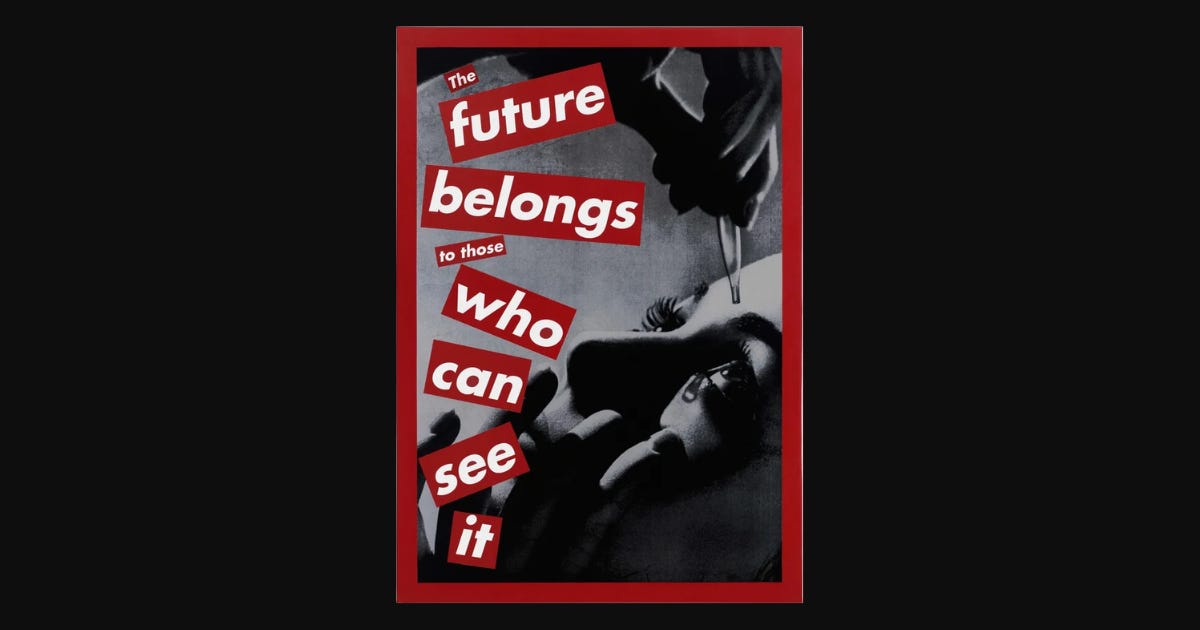
I’ve been quiet here in recent weeks, as the combination of finishing a big writing project and continuing on amidst geopolitical uncertainty left little space in my brain or my life for new questions, new lines of inquiry, or new conversations.
After all, it’s hard to imagine a future if the ground you’re standing on feels like it’s shifting.
Which has got me wondering: we’re living in a moment of accelerated technological, ecological, and economic change globally. But change makes it harder to act: how do you know what’s true, and what will continue to remain true?
If the sands beneath our feet are always shifting, how do futures get built, with any intentionality? What premises about the future can we hold to be true, even in the face of waves of change, and what premises can we build foundations upon? In the worlds I’ve lived in (media, economics, policy, startups), these are often questions translated into complex equations that model individual human behaviour, collective market behaviour, factoring in resources, infrastructure to connect us to each other, and the chess game that is human interaction.
What we believe to be true about how we live alongside each other determines whether and how systems change, new markets emerge, new paradigms get adopted, and new ways of living become the norm.
It’s easy to think that the future is just a fortunate (or unfortunate) accidents that we stumble into, but I can’t shake the conviction that it’s something we architect. After all, I live in a city that is a shining example of a future that was intentionally shaped and created, not stumbled into by an accident. It was a choice, a decision, about what a small fishing village could turn into, what an oasis in a desert could be, and the consequence of an investment into building it.
At the same time, every morning, I wake up to headlines of diplomacy’s steps forward or failures overnight, and it’s not lost on me that the future is not brought in only by one person or one regime deciding what should be. It’s co-created, because we are all stakeholders in the future.
So how do we bring people with different needs or viewpoints together? How do we get them looking in the same direction, so that our individual and collective futures are pointing, again and as always, in the direction of possibility?
I won’t promise answers, but I want to take you down this rabbit hole with me. I’ll be writing every week, again, as I explore who and how the future is being and can be shaped. Looking, as always, to thinkers and builders, to history as well as to present-day, to investors and policymakers, to understand what we want to build and how we make it happen.
Three things that I keep returning to, about who and how the future is shaped:
1. This essay by Jasmine Sun in The New York Times, which quotes tech workers in Silicon Valley sharing fears that AI is about to “create a permanent underclass,” has been making the rounds in my feeds.
There’s something about how it’s written that stops me in my tracks. As if the boulder is already rolling down the hill and there’s no stopping it. As if the future is inevitable, and not something that is constructed and shaped by us, especially those of us who are at the helm of steering capital and technology. Where is this sense of lack of agency coming from?
It’s the same tone I sometimes hear when people talk about climate change, rising temperatures, and how we ensure a thriving and inhabitable planet for future generations.
2. This clip from Trevor Noah’s podcast about how people in sub-Sahran Africa are generally more optimistic about the future of AI than people in the West (the study that they talk about here, alongside some context and skepticism)
They talk about the technology and uncertainty that it brings with it as an equaliser across existing geographic and socioeconomic inequality. If the change is coming at all of us, maybe the change could make things better for some people who have been existing in places with less access to opportunity or fewer resources?
I wonder about recent history of change in different regions and its correlation to whether people are optimistic or pessimistic. It’s easy to dismiss optimism as naivety and pessimism as cynicism, but they’re both useful data about whether the trajectory of change feels like it’s serving us, whether we’re in the habit of the world working for or against us.
3. This TED talk by Carissa Véliz, an Oxford philosophy professor, is one I can’t stop thinking about, where she warns of the power of prediction and prophets. Her argument is simple: predictions aren’t neutral information, they are participatory and powerful. They shape the future.
This is a conversation I remember having early on in my career when I worked in newsrooms in the United States. We were building a prediction engine with statisticians and experts, the kind that shows predictions for election results depending on polling, headlines, and socioeconomic indicators. Engineers had spent weeks building and refining. It was a few days before the election, and we were getting closer to hit publish when a seasoned editor asked how the existence of this engine would impact voter calculus. Would people act differently because of the predictions? Would they go out to vote less if they felt that their vote didn’t count because the decision had already been made?
Information isn’t neutral, it has consequences. The stories we tell shape the world we live in. Both on the societal, and on the personal.
A few years ago, a colleague brought a deck of tarot cards to the office and started making predictions for colleagues. It was all good fun, and I was ready for a laugh when it was my turn: would she predict love or money or travel?
Instead, we sat in a conference room with cups of tea, and she said to me, “Oh Masuma, these cards are dark, they’re really dark. I’ve never seen something like this, you’re really going through it, look at this card - you’ve been up all night in worry.” I had been sleeping just fine, no extraordinary worry keeping me up all night. I knew this wasn’t meant to be an actual prediction, but the seed had been planted in my head and in the coming weeks, I found myself wondering late at night if I should be worried. Was I not seeing my own worry? She spoke with such authority, could she see something I couldn’t?
I’m left with a simple question that will be shaping my curiosity in weeks to come, and I hope yours too: What kinds of predictions would help shape the future into a thriving, more possible one? Where are there examples of this happening and what can we learn from them?
I love the positivity threaded throughout this! We need more of this.